 English
 Русский

June 2026 clearly proves that global warming hits IT directors' pockets just as hard as it hits glaciers. While European citizens raid stores for fans, hosting provider infrastructure is splitting at the seams. Server racks designed for a mild European summer face a brutal reality where outdoor temperatures easily cross +34 °C. As it turns out, praised cloud technologies do not tolerate simple physical overheating.
The Dutch Knot: Misfortunes Seldom Come Alone
Eastern European hosting clients who traditionally rent capacity in the Netherlands took a heavy hit. The Amsterdam IT hub, long considered a gold standard of reliability, turned into a high-stress zone this season.
Trouble began back in May when a major fire at NorthC Datacenters' AMS03 facility in Almere destroyed emergency power systems. The incident rippled out to affect giants like IBM Cloud. By June, the damage was not fully repaired. The sudden anomaly of extreme heat caught the surviving cooling systems off guard. The weakened infrastructure works at its absolute limit while the Dutch power grid groans from millions of household air conditioners and industrial chillers switching on simultaneously.
Laws of Physics vs. Digitalization
The issue is widespread because most European data centers were historically built to handle peak temperatures of up to +32°C. Now, with forty-degree heat outside, traditional chilling machines physically fail to reject heat into the scorching atmospheric air.
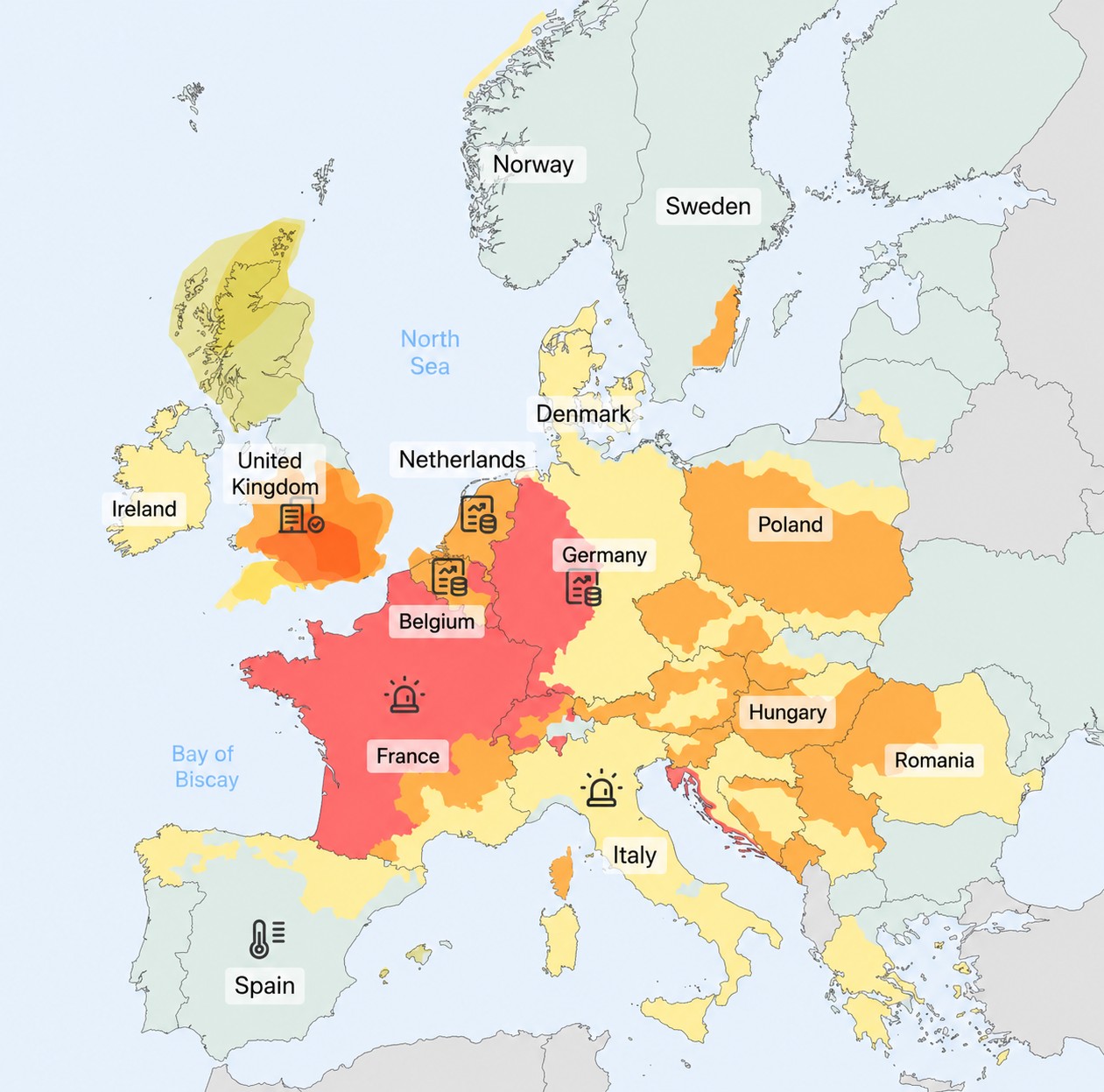
Image: RBC / European Meteorological Network
A so-called thermal plume effect forms around data center buildings. Powerful processors generate megawatts of energy while air conditioners try to push this heat outside. As a result, server stations literally suffocate in their own hot air.
The Bitter Experience of Tech Giants
The situation in June 2026 brings back memories of past temperature records when even monopolies like Google Cloud and Oracle went down. When automation flags critical overheating, operators face a narrow choice: watch expensive hardware melt or forcefully shut down servers.
This June, radical shutdowns reached the UK. Amid thirty-degree heat, industrial chillers failed entirely at the Queen Alexandra Hospital data center in Portsmouth. IT systems instantly dropped offline, forcing medics to cancel scheduled surgeries. Meanwhile, in Turin, Italy, underground power cables began to burn out from thermal stress. Local hosters received polite hints to cut power consumption, which translated to a sharp drop in website loading speeds for end users.
The European IT market faces a new reality. Hosting providers must either invest heavily in expensive liquid cooling or get used to the fact that their businesses will remain in a semi-conscious state every single summer.