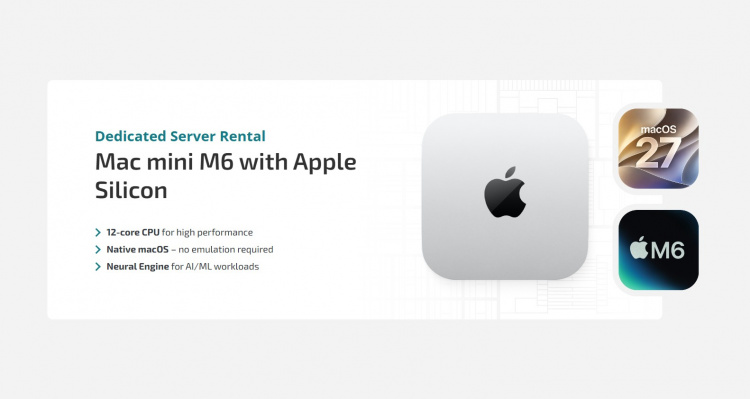
Such machines are already available for order, offering those who have hit the performance ceiling of their legacy hardware a rather weighty argument for migration
Users can now independently verify the accessibility of their virtual server from Russia, rather than waiting for the problem to magically resolve itself
The condition for gaining access is extremely simple: possessing any active server linked to the account. Purchasing special configurations or allocating additional computational power to use the service is entirely unnecessary
The main advantage here is native macOS without a hypervisor layer, guaranteeing full compatibility and remote GUI access exactly as intended in Cupertino
Users no need to wait for a rack technician to manually plug in cables; automation now allows the infrastructure to be deployed within minutes of purchase
In exchange for the infrastructure, the provider demands one honest piece of content about the user's experience with their services. The format is flexible: it can be an article, a review, a social media post, or a video
Direct server access via DirectAdmin remains untouched. Existing hosting and email passwords stay exactly the same. Crucially, active billing cycles and pricing structures are grandfathered in and will not increase for current contracts
This balance of resources is aimed at those deploying large language models (LLMs), experimenting with neural network fine-tuning, or handling image generation and video processing
M1Cloud services will continue to operate in standard mode, and the conditions of existing contracts for current clients will remain unchanged. This is a classic M&A maneuver: promising that nothing will change, except that clients will supposedly gain access to a new layer of infrastructure resources and expertise
 English
 Русский