 English
 Русский
Webdock has launched Webdock Private Cloud, a new service aimed at organizations that have outgrown standard VPS hosting but do not necessarily want to jump straight into the complexity of hyperscale public cloud platforms.
The service provides single-tenant infrastructure hosted entirely in Webdock's own data center in Denmark. The underlying hardware is reserved exclusively for one customer, eliminating shared compute resources, resource overcommit and the performance fluctuations that can come with multi-tenant environments.
In infrastructure terms, the neighbors have been shown the door. The customer gets the hardware to itself.
A dedicated cluster with the Webdock platform on top
Private Cloud is designed for organizations that need hardware isolation, consistent performance and greater control over their infrastructure. Webdock lists business-critical applications, SaaS platforms, high-traffic websites and databases among the intended workloads, along with projects subject to strict security and compliance requirements.
The infrastructure remains in Webdock's Danish data center, placing it under Danish jurisdiction and European law.
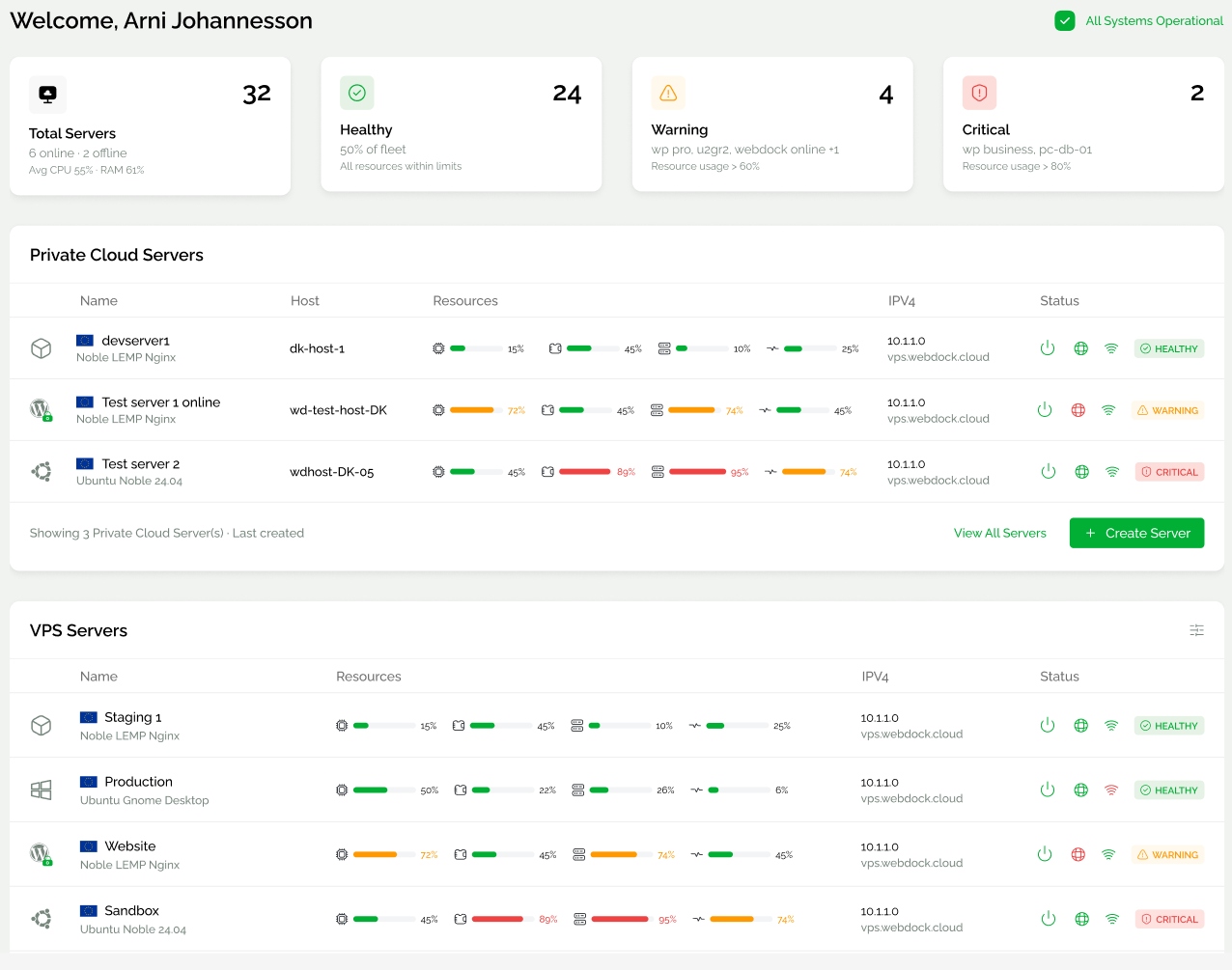
Unlike a traditional dedicated server, however, Private Cloud does not leave customers alone with a machine and a root password. The service retains the Webdock platform layer, including the company's dashboard and API.
Customers get access to instant provisioning, snapshots, backups, monitoring, API access, DDoS protection and Web Application Firewall support. Team management features available through the Webdock platform are also included.
The result is a hybrid approach: dedicated hardware underneath, cloud-style management on top. The server gets its own room, while the control panel still gets to behave like a cloud platform.
No overcommit, with room for traffic spikes
One of the central characteristics of Private Cloud is the absence of resource overcommit. Hardware resources assigned to the customer's infrastructure are not simultaneously sold to other customers on the assumption that everyone will somehow refrain from using them at the same time.
That approach is intended to provide more predictable performance and monthly costs, which can be particularly important for business-critical workloads.
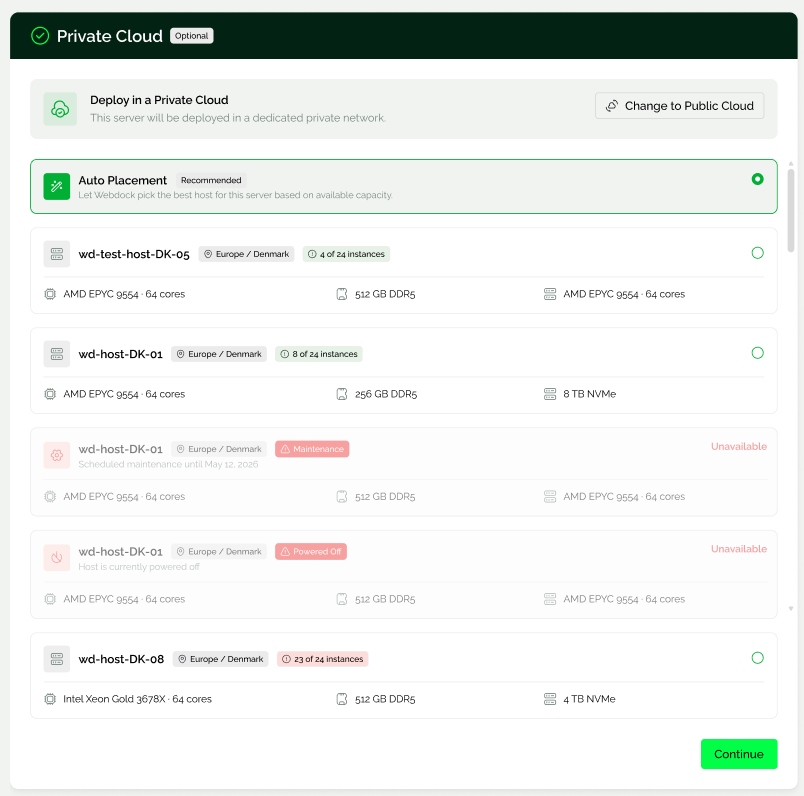
Webdock also allows customers to choose between different host configurations and change the selected host later if requirements evolve.
There is an additional escape hatch for temporary demand spikes. Private Cloud environments can burst into Webdock's public VPS platform when additional capacity is required.
This means a business can handle a sudden traffic surge without permanently overprovisioning its dedicated infrastructure. The public and private environments are managed through the same dashboard and API, so scaling does not require learning an entirely new operational toolkit.
Who is Private Cloud for?
The service is primarily aimed at businesses whose infrastructure requirements have moved beyond conventional VPS hosting.
SaaS providers, operators of high-traffic websites, companies running business-critical applications and organizations with demanding security or compliance requirements are among the most obvious candidates. Dedicated hardware can provide greater isolation and more predictable performance while keeping the operational model relatively close to standard cloud hosting.
For a small website or a typical application that runs comfortably on a VPS, Private Cloud would likely be excessive. Building a private infrastructure environment for a modest blog would be rather like renting a warehouse to store a bicycle.
For a growing business, however, the service occupies a useful middle ground between VPS hosting, traditional dedicated servers and hyperscale public clouds.
Danish infrastructure and enterprise options
Webdock says it owns and operates both the hardware and the data center in Denmark. This keeps the infrastructure within Danish jurisdiction and European law while giving the company direct control over the physical environment.
Additional enterprise-oriented options include Bring Your Own IP (BYOIP), enterprise networking and advanced operational SLAs.
Webdock Private Cloud therefore represents more than another VPS tier with a larger CPU and RAM allocation. It is an attempt to combine the physical isolation of dedicated infrastructure with the operational convenience of a cloud platform.
For businesses that have reached the limits of conventional VPS hosting, that combination could provide a middle step before making the much larger move into hyperscale cloud infrastructure.