 English
 Русский

The developers behind DataLife Engine have announced the release of version 20.0, a milestone update that introduces significant architectural improvements, expanded artificial intelligence integration, and a broad range of enhancements for administrators, editors, and website owners.
Judging by the scope of the changelog, DataLife Engine 20.0 is less of a routine update and more of a comprehensive overhaul of several core components that have been quietly carrying the platform for years.
AI Takes a Larger Role Across the Platform
Artificial intelligence is one of the central themes of DataLife Engine 20.0. The CMS now supports multiple AI APIs out of the box, including Google Gemini, Yandex GPT, Anthropic, and OpenAI Responses.
The release also introduces a new proxy system for AI requests. Instead of sending requests directly from a user's browser, the platform can route them through the server hosting the CMS. This approach helps protect API credentials and can simplify access to AI services in environments where availability depends on geographic location. Sometimes a server turns out to be more diplomatic than a browser.
Another notable addition is an AI-powered comment moderation system. Beyond detecting explicit profanity, it is designed to identify more subtle forms of harassment and personal attacks. Site administrators can choose whether problematic comments should be rejected, sent for manual review, or automatically rewritten into a more acceptable form while preserving their original meaning.
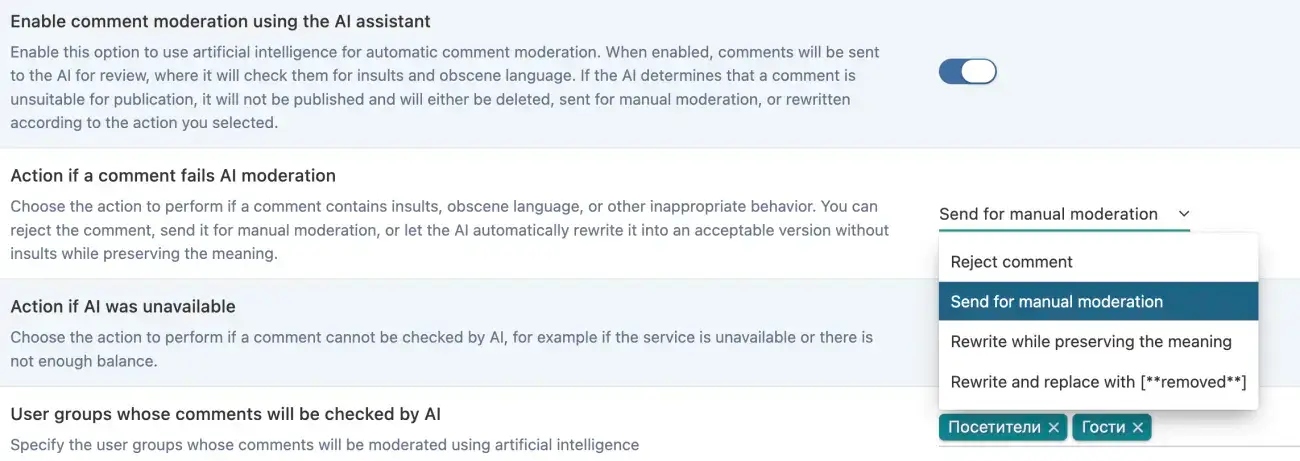
To prevent abuse, the platform also introduces safeguards against users attempting to exhaust AI moderation quotas by repeatedly submitting inappropriate content. The system can count rejected comments toward existing posting limits, making endless moderation battles a less attractive hobby.
Smaller Footprint, Faster Operation
One of the most substantial changes in version 20.0 is a complete redesign of the platform's third-party library architecture. DataLife Engine has removed its dependency on Composer-based integration layers, preserving the required functionality while eliminating a large amount of overhead.
According to the developers, the distribution package is now more than 8 MB smaller and contains over 1,600 fewer executable files. Memory consumption has also been significantly reduced in various scenarios, while startup performance has been improved.
The database backup and restoration subsystem received a major overhaul as well. The new implementation utilizes transactions and streaming operations, allowing backup processes to run considerably faster on large datasets. In some environments, backups may now finish before an administrator has time to refill a coffee mug.
Additional optimization work targeted image processing, caching mechanisms, the administration interface, and several core modules. The control panel has also been migrated to jQuery 4, while its CSS codebase underwent extensive cleanup to remove unused components.
More Languages and Better Editing Tools
Localization has been expanded considerably in the anniversary release. DataLife Engine now includes additional language packs covering German, French, Spanish, Portuguese, Polish, Turkish, Chinese, Arabic, and several other languages. The total number of supported localizations has reached 18.
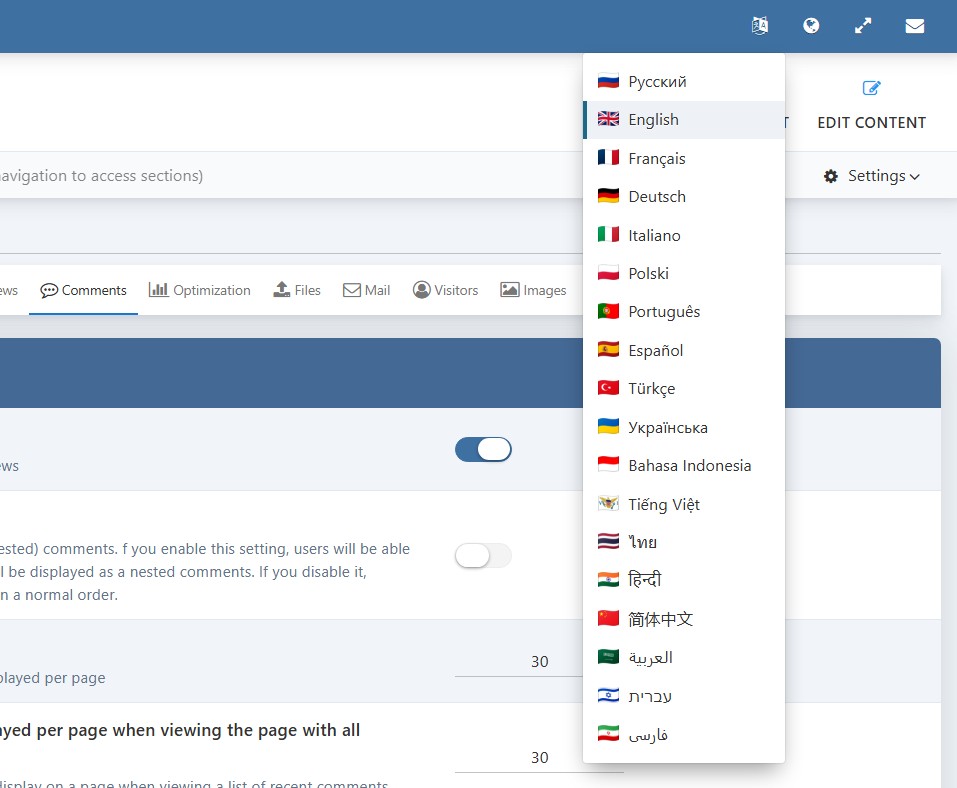
The installation process has also been updated with a new template compilation system. As a result, standard templates and interface elements are fully localized during installation, including automatic right-to-left support for languages that require it.
Editors and content managers receive an updated content editor, improved Microsoft Word document import capabilities, a new native emoji system based on Unicode 17.0, and more flexible controls for text sizing and formatting.
Among other notable additions are an upgraded protected-link system using AES encryption, a new HTML-based documentation package, ISO-compliant transliteration support for languages worldwide, tabbed template editing, improved external image handling, and a redesigned social authentication module.
The release also includes numerous interface refinements, performance improvements, and bug fixes.